Introducing Martial Active: From Idea to App
by Ian Ebden in Application Development, Craft CMS, Usability, UX.
Every now and then, an idea comes along that you just can't leave alone. For me, that idea was Martial Active — a workout application designed specifically for people who practise martial arts.
As a keen karate practitioner, I've spent years combining martial arts training with sessions in the gym. But I've often found myself asking the same question: what should I actually be doing in the gym to improve my martial arts?
The fitness app sector is obviously very crowded, but most apps are designed around general strength training, bodybuilding or weight loss. I wanted something a little different and much more targeted. Something that understood the physical demands of martial arts and could provide practical, personalised, structured workouts without requiring hours of planning. So I decided to build my own app.
What started as a small side project has gradually evolved into Martial Active — and it's been an enjoyable reminder of why I got into web development in the first place.
Starting With a Simple Problem
The original concept was deliberately straightforward. Imagine arriving at the gym, opening an app and being presented with a personalised workout designed to complement your martial arts training. No complicated programming. No endless exercise library to navigate. Just a sensible workout based on the equipment you have available and what you're trying to achieve.
Martial artists have slightly different priorities from the average gym-goer. Strength is important, but so are explosive power, endurance, mobility and the ability to perform under fatigue.
And whether you practise karate, taekwondo, kickboxing, judo or another discipline, those physical qualities can make a real difference. The challenge was to build something that recognised those needs without becoming unnecessarily complicated.
That last part was particularly important to me. I've always believed that good software should make people's lives easier, not introduce another layer of complexity.
Designing for the Real World
One of the most interesting aspects of developing Martial Active has been designing an interface that works in a gym environment – it's quite different from designing a conventional business website.
Users might be tired, sweaty, wearing gloves or trying to interact with their phone between exercises. They don't want to navigate complicated menus or spend ages entering information. The interface needs to be clear, responsive and forgiving.
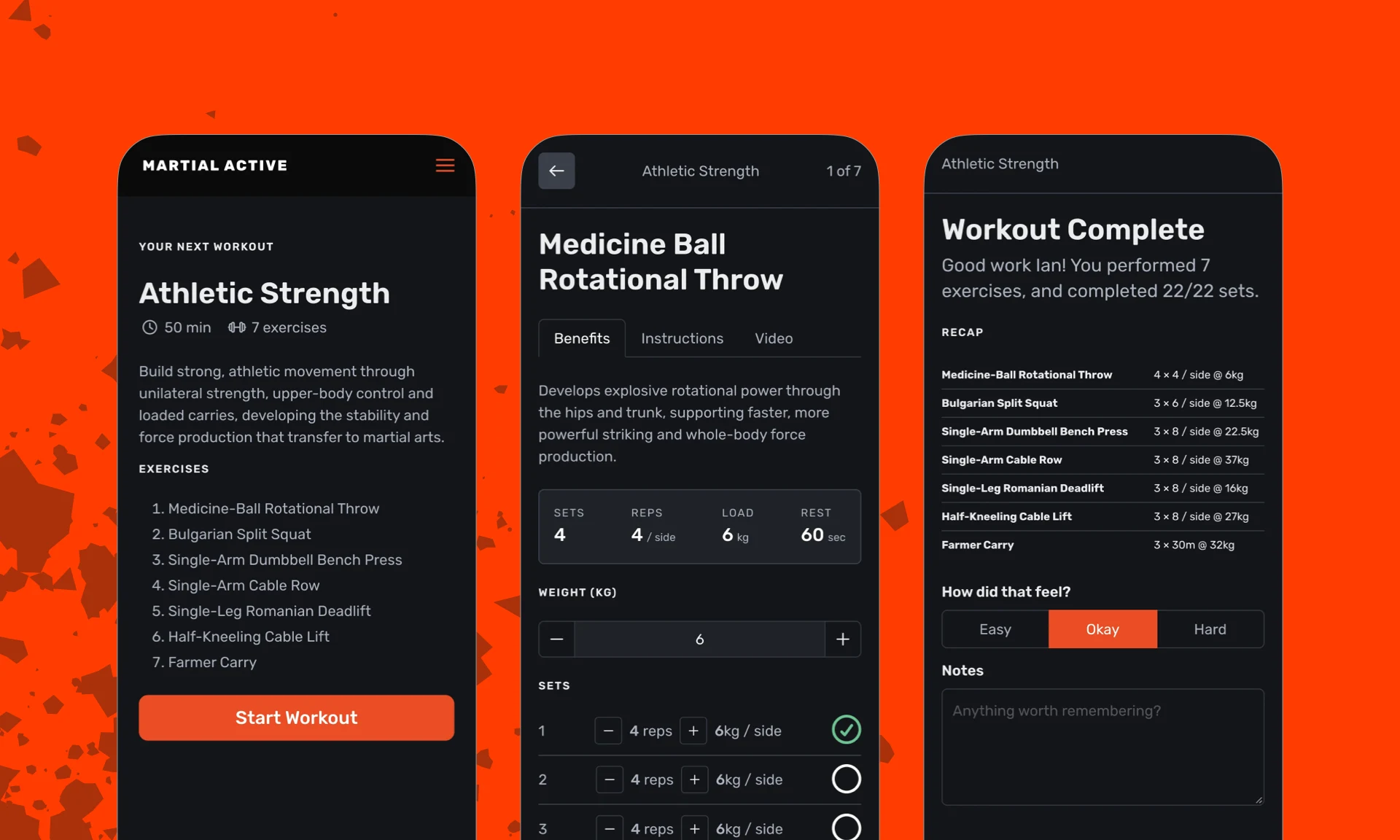
That has influenced everything from the size of buttons and typography to how exercises are presented, how sets are recorded and how rest periods are managed.
The application guides users through their workout, allowing them to record sets, adjust weights, monitor rest periods and track their progress over time.
I've also spent a good amount of time thinking about seemingly minor details, such as what happens when a phone's screen goes to sleep during a rest timer, or how the interface behaves when the gym's mobile connection is particularly slow.
These aren't necessarily the features that make it into a product description, but they're often the details that determine a positive user experience.
And because I'm using Martial Active for my own workouts, I get to uncover any friction or shortcomings first-hand, so I can fix them when I'm back at my desk.
Building an Application With Craft CMS
From a technical perspective, Martial Active has also been an opportunity to explore a slightly different side of Craft CMS.
Most people associate content management systems with websites, blogs and online stores. But Craft's flexibility makes it a capable foundation for more sophisticated web applications too.
I chose Craft CMS 5 to manage the application's underlying content and data, alongside Twig, Alpine.js and Bulma for the front end. It's a technology stack I'm very comfortable working with, and one that allows me to develop quickly without introducing unnecessary complexity.
Craft provides a flexible content architecture for managing exercises, workouts and other application data, while its user management capabilities provide a foundation for individual accounts.
Alpine.js handles much of the interactive behaviour in the browser, and Bulma provides a lightweight, responsive CSS framework.
The result is a web application that feels dynamic and interactive without requiring an elaborate front-end framework or an unnecessarily complicated development process.
That's not to say there haven't been technical challenges.
Managing workout progress, recording individual sets, handling timers and ensuring the interface remains responsive have all required careful thought. But those challenges are part of what makes building something like this so rewarding.
The Value of Building, Testing and Refining
One of the biggest lessons from Martial Active has been the importance of testing software in the environment where it's actually going to be used.
Something that works perfectly while sitting at a desk can feel very different when you're trying to use it at the gym.
I've already made numerous changes based on my own experience, from simplifying the workout interface to improving the way rest timers and exercise information are presented.
Some features that seemed essential during the planning stage have become less important. Other requirements only became obvious once I started using the application regularly.
It's a useful reminder that successful software development isn't simply about delivering a predetermined list of features. It's about understanding how people actually use a product, listening to feedback and being prepared to refine the original idea.
The same principle applies whether I'm building a bespoke web application or a relatively straightforward business website.
Where Things Stand Today
Martial Active is currently in private beta, with the core application up and running and ongoing testing helping to shape its development.
There's still plenty I'd like to improve, and I have a growing list of ideas for future features. But I'm deliberately resisting the temptation to add everything all at once. For now, the priority is to make the fundamental experience as useful, reliable and enjoyable as possible.
The public website is already live at martialactive.com, where you can learn more about the concept while development continues. I'm looking forward to opening the application to a wider audience when it's ready.
More Than Just Another Side Project
Although Martial Active started as a personal project, it's become a useful opportunity to bring together several things I enjoy: martial arts, fitness, design and web development.
It's also given me the freedom to experiment, make mistakes and explore ideas without the usual constraints of a client brief.
Perhaps most importantly, it's reinforced something I've believed throughout my career.
The best digital products begin with a clearly understood problem, not a long list of features.
Whether I'm developing a Craft CMS website for a business or building an application like Martial Active, the process is fundamentally the same.
Understand what people need. Design an experience that makes sense. Choose technology that's appropriate for the job. Then test, refine and improve.
Have an Idea of Your Own?
I've been designing and developing websites at DesignKarma since 2007, with a particular focus on Craft CMS and bespoke web development.
Martial Active is a good example of how that experience can extend beyond traditional websites into more interactive, application-style projects.
If you have an idea for a website, digital product or bespoke application, I'd be happy to discuss how to bring it to life.
And if you're a martial artist yourself, feel free to take a look at Martial Active and follow on Instagram. It's still early days, but I'm excited to see where the project goes.


Thanks for reading